
Annual Report and Accounts 2024-25
Annual Report and Accounts reports on the business and financial activities undertaken by AiB over the last financial year
Performance analysis
Measuring performance – Business objectives
AiB’s primary strategic purpose is to ensure the efficient and effective delivery of Scotland’s statutory debt relief and debt management options – both those cases we manage ourselves, and those for which our role is a supervisory and regulatory one. We also aim to help Ministers ensure Scottish insolvency and debt management legislation and solutions effectively address the challenges society faces today.
There were 52,300 live cases at the end of 2024-25 (2023-24: 52,900), comprising bankruptcies, protected trust deeds (PTDs) and debt payment programmes (DPPs) under the Debt Arrangement Scheme (DAS). All PTDs are administered by insolvency practitioners, as are some bankruptcies. Most full administration bankruptcies are administered on our behalf by private sector insolvency practitioner (IP) firms working under contract. DPP’s under DAS are jointly administered. All Minimum Asset Process (MAP) cases and some full administration bankruptcies are fully administered “in house” by AiB.
AiB’s 2024-25 business plan set out six actions we would deliver over the year alongside keeping track of the ongoing business objectives. These six actions reflected the Advisory Board’s desire that we make our continuous improvement agenda more transparent and measurable.
This report reflects the success delivering all six actions and maintaining our strong record of meeting our key performance targets, particularly working reduced hours under the flexible working pilot. Completing these has put AiB in a stronger place to face future challenges. Our successes are testament to the AiB staff who consistently demonstrate their adaptability and ability to rise to those demands.
Action 1 - Flexible working pilot
Action 1 – Flexible working pilot
The Flexible Working Pilot (FWP) commenced on Monday 15 April 2024 following a Staff consultation exercise. Participation in the pilot was voluntary, and all AiB staff opted to take part. During the pilot, full-time employees had their working week reduced to 32 hours over four days, while part-time staff saw a proportional reduction in their hours. Our regular Monday-to-Friday service continued without interruption throughout the duration of the FWP.
The Autonomy Institute and its academic partners were commissioned by the Scottish Government to help coordinate the pilot and investigate its impact on service delivery and staff well-being. A baseline survey was conducted at the pilot’s outset so its impact could be measured accurately. As the year progressed, two additional staff surveys were held, and a cross-section of employees were interviewed to gather their experiences of the FWP. Key Performance Indicator (KPI) data was also analysed to assess business clearance times, and a stakeholder survey was conducted to gauge how our service users felt about the quality of service provided.
Prior to launching the pilot, working practices were reviewed to streamline processes where possible and identify potential time-saving measures. Meeting durations and frequencies were also assessed, leading to a reduction in both, thereby freeing up staff time to focus on service delivery. The transition to the FWP went smoothly, with no major issues reported. An FAQ document was created at the outset to address common questions and provide practical guidance on time-recording and annual leave during the pilot.
Our quarterly key performance indicator data showed that service levels were maintained throughout the pilot with targets achieved across the board. The quarterly clearance times for processing debtor bankruptcy applications, Debt Arrangement Scheme Debt Payment Programme applications and protecting Trust Deeds are detailed later in the report.
In November, we received the results of the stakeholder survey. The feedback on our service provision was overwhelmingly positive, with 328 responses received. Of these, 77% were from individuals currently or previously in a statutory debt solution. Among the 129 respondents who had recently contacted AiB, 95% received the information they were looking for. 60% rated their experience as excellent, contributing to an overall weighted score of 4.43 out of 5. Additionally, 87% of those who contacted AiB by phone found it easy to reach the right person, with 74% reaching the right person on the first attempt. 90% of respondents reported that their call was answered promptly, and 90% were either very satisfied (64%) or satisfied (26%) with how their query was handled.
Improving staff well-being was one of the main objectives of the FWP. The Autonomy report, which was completed toward the end of the pilot, highlighted significant improvements across various well-being metrics. Mental health self-assessments showed an 18.4% improvement, while work stress scores dropped by 18.4%. Further improvements were noted in areas such as fatigue, burnout, and sleep quality. Additionally, the average satisfaction score related to time management increased by 46.8%, and participants reported a significant boost in overall job and life satisfaction. Overall instances of sickness saw a modest drop and there was a significant reduction in sick days taken for psychological reasons, a decrease of 25.7% during the pilot period compared to the previous year.
In February 2025, it was agreed the FWP would be extended until the end of June 2025, with a further extension to August 2025 agreed at the end of April 2025. Overall, AiB’s experience of the FWP has been very positive, illustrated by the improvement in staff well-being whilst maintaining service delivery.
Action 2 – Cloud Project
Action 2 – Cloud Project
In 2024-25 we continued transferring our case management systems to the Scottish Government cloud platform.
The purpose of the transfer is to:
- improve accessibility to AiB systems
- reduce dependency on both hardware and software
- provide higher performance levels and availability
- enable quicker application deployment
- enhance cyber security
- improve business continuity
- reduce costs
AiB created a test environment in the cloud and have successfully tested AiB’s main case management applications.
As a result of this progress, AiB uses the cloud platform exclusively for testing AiB systems negating the on-site testing system which was due for replacement. The on-site system will be decommissioned in the coming months and has already been powered off representing a reduction in electricity usage and savings on the replacement of the equipment and software licences.
Penetration testing was undertaken during the year with further testing scheduled from April 2025. AiB continue to work with Scottish Government on connectivity. AiB will undertake the remaining steps on our transition to Cloud during 2025-26, including data migration, and pending available support from the Scottish Government. We are confident that risk to service delivery remains low with our current platform remaining fully supported.
Action 3 – Digital mailroom
Action 3 – Digital mailroom
In 2024-25 we aimed to continue our move to digital by default by increasing the number of processes carried out electronically. This has driven a reduction in the number of pieces of physical mail passing through the office, in turn allowing us to consider the option of a fully digital mailroom.
To do this we explored the functions and roles of the existing service and confirmed a plan for future direction of the function.
Supplier meetings were held to help understand the “art of the possible” and what solutions exist to help solve some of the challenges AiB are facing in inbound and outbound mail, as well as email. The supplier engagement helped uncover solutions capable of hybrid mail allowing emails to be issued, and for chased and physical mail to be produced if emails were unread. Some solutions were also able to access mailboxes and handle incoming email.
Good progress has been made in designing the way forward which will be implemented in the coming year.
Action 4 – Oracle go-live
Action 4 – Oracle go-live
Oracle is the new Human Resource (HR) and finance system being implemented by Scottish Government. The Oracle system went live in October 2024 with Finance going live on 1 October 2024 followed by HR from 7 October 2024.
A red team was set up to give delivery bodies a platform to raise issues and concerns, share lessons learned. Issues are triaged and then escalated where appropriate.
Learning materials were made available on Pathways to guide staff through everything from day-to-day functionality to specialist, job specific tasks. Some of this training was mandatory before access could be granted to staff using the system.
Regular news bulletins were issued by AiB's Communication team to ensure staff awareness of upcoming changes and confidence in using the system.
Position management was introduced as part of Oracle to effectively plan, manage, and report on the positions within our organisation. This includes both filled and vacant positions, enabling a comprehensive overview of the workforce structure and providing a stable foundation for workforce planning, budgeting, and organisational management.
AiB’s Business Development team attends SG's Senior Business Managers working group to stay up-to-date on Oracle Position Management. Changes to AiB’s organisational structure in Oracle commenced in late 2024 to align with SG’s position management framework. Beginning in early 2025, the focus will be on updating Directorates, Divisions, and Branches, followed by the Chart of Accounts, to ensure staff are accurately aligned to the appropriate positions.
Action 5 – AiB Building Space (prepare for new co-tenants)
Action 5 – AiB Building Space (prepare for new co-tenants)
The Scottish Government’s Estate Strategy is being developed to support effective planning for a hybrid working organisation in the years ahead. This enables ministers to make informed decisions about the long-term future of our buildings.
Following earlier discussions with Scottish Government Estates around a potential co-tenancy at our office at 1 Pennyburn Road, Kilwinning, the business case for moving staff from Russell House to Kilwinning was accepted in Autumn of 2024 and preparations have begun to facilitate the move expected to take place in January 2026.
During 2024-25 we focussed on preparing office space and exploring the scope for a shared corporate service.
Staff from Russell House have been able to visit Kilwinning and will be included in a working group with AiB staff from May 2025 to ensure the move goes smoothly. There are some areas where AiB can assist the new tenants such as Mail and reception duties and this will be taken forward by the working group.
Action 6 – Mental Health Moratorium
Action 6 – Mental Health Moratorium
The introduction of a Mental Health Moratorium in Scotland, which will provide special protections from debt enforcement for those individuals with serious mental health conditions, has received broad support from stakeholders.
The Bankruptcy and Diligence (Scotland) Act 2024, which includes the Mental Health Moratorium provisions, was approved by Scottish Parliament in June 2024. A consultation on draft regulations was carried out from 9 December 2024 to 17 March 2025.
The next steps are analysis of the consultation and further engagement with stakeholders. The 2024 Act includes a “super-affirmative” process, which requires Ministers to submit a revised draft of regulations to the Economy and Fair Work Committee of the Scottish Parliament, and have regard to any representations on them, before formerly laying the regulations to bring a Mental Health Moratorium into force.
Other Corporate Activities
Other Corporate Activities
Stage 3 Review of Insolvency Products
The terms of the MacDermid stage 3 review of insolvency products are to undertake an examination of the range of statutory debt solutions in Scotland and to make recommendations to meet the needs of a modern economy. The review builds on the previous Stage 1 and 2 reviews.
An initial call for evidence from stakeholders was carried out from 24 May 2024 to 18 July 2024. Following analysis of this a roundtable took place in November 2024 and sector specific workshops in December 2024. A further roundtable to consider values and principles took place in January 2025. A consultation was published on the AiB website in March 2025, which is open until 4 June 2025.
Corporate Parenting
In 2024, we launched our 2024–2027 Corporate Parenting Plan, which sets out our commitment to supporting Care Experienced individuals. The plan focuses on:
- Challenging stigma and improving the language we use
- Building stronger relationships
- Creating employment and development opportunities
- Continuously evaluating and learning from our work
Since launching the plan, we've partnered with local corporate parenting organisations, including North Ayrshire Council. During Care Awareness Week, a colleague bravely shared their personal experience of being Care Experienced, helping to raise awareness and understanding across our organisation.
As part of the UK Government’s Multiply campaign—which aims to improve adult numeracy—we’ve run three 'Digital Skills for Bills' workshops. These sessions helped Care Experienced young people learn about budgeting, managing debt, understanding credit scores, and organising their finances—giving them valuable life skills.
We are committed to continuing this work over the coming year, making sure Care Experienced individuals get the support and opportunities they need to thrive.
Procurement and contracts
During 2024-25 AiB explored options around its highest value contract, for insolvency services, due to end next year. A project board and user intelligence group were established and work on project documentation commenced.
The initial stage of the project was to model the existing process and produce an options appraisal.
AiB identified there are a number of unknowns in terms of upcoming legislation changes which may affect this contract. AiB continue to work with relevant parties to establish the best course forward.
Stakeholder engagement
The communications team drafted a new AiB communications strategy during the year, due for sign-off and commencement in 2025. Our communications vision is to:
- deliver an accessible service through our communication channels
- support the core agency objectives by continuously improving our communications whilst engaging actively with our stakeholders
- strengthen our online presence and appearance by aligning with Scottish Government Digital Standards
- provide the end user with a clear and impactful journey across our digital services and publications
Different customer surveys were carried out during the year in support of the flexible working pilot evaluation. All stakeholder engagement reflected no impact on AiB’s services.
AiB’s delivery teams continued to have bespoke stakeholder working groups looking at bankruptcy, DAS and trust deed process. Full sector events are planned for 2025-26.
Cyber security and IT resilience
The focus on Cyber Security remains and the cyber security team now has flexibility to adapt to the ever-changing cyber landscape. Quarterly reports are presented to the Advisory Board and Audit Committee advising of progress made and any major cyber issues that have had an impact on the functions of AiB. Cyber security remains the highest risk on the AiB corporate risk register and forms part of all risk management discussions. During the year, monthly vulnerability scans have been carried out along with frequent scans on public facing infrastructure.
Cyber Security Incident
In December 2024 suspicious activity was detected on one of our web servers by the Scottish Government Security Operations Centre. The issue was swiftly contained by taking the affected site offline and removing the vulnerable setup, and no further signs of compromise were identified. To ensure continuity, an interim solution was provided for subscribers to our Register of Insolvencies (ROI) data download service, allowing them to receive daily file updates during the outage.
IT colleagues confirmed that no data had been exfiltrated and the broader network remained secure. The data contained within the system is searchable public information, and it was confirmed that there was no data breach. As such, there was no requirement to report this to the ICO. However, as a precaution, the decision was made to rebuild the server. This task was managed by the core Scottish Government IT service. Normal service to the ROI was subsequently restored. Prior to full restoration, and to ensure stakeholder business continuity, a manual search service was made available for ROI users, completing over 650 searches. A lessons-learned meeting was conducted to assess response effectiveness and identify strategies to mitigate future risks.
Phishing
One key cyber risk for AiB has been phishing and the potential impacts associated with phishing emails. Training and education sessions continued throughout 2024-25. Phishing training now forms part of AiB’s induction process. In January 2025 AiB held its second annual cyber security week for all staff. This covered most cyber issues and related areas such as fraud. AiB will continue to raise awareness of phishing and how to spot potential attacks.
Estates strategy
AiB is well-established in Kilwinning, having moved to its current premises in 2006, and a high proportion of AiB’s staff are drawn from the local area. AiB holds a building lease until October 2035 with an option to break the lease in 2030.
Action 5 detailed in this Performance Report details how AIB are working with Scottish Government estates to prepare our building for new co-tenants, due to arrive from January 2026.
The new lighting and solar panels were installed during 2024-25, with benefits of these detailed under the sustainability section.
Finance report
Finance report
In December 2022, the Auditor General appointed Stephanie Harold, from Audit Scotland, as the external auditor to AiB for the period 2022-23 to 2026-27.
For the financial year ended 31 March 2025 AiB were again issued an unmodified opinion on the annual report and accounts.
This is supported by assurances from internal audit on the Scottish Government corporate systems used by AiB.
These accounts were prepared under the Accounts Direction by Scottish Ministers detailed at Appendix A. They were prepared on a going concern basis, which means AiB intends to continue its business for the foreseeable future and is able to do so.
Budget, resource and financial performance
The cost of operating AiB is met predominantly through income raised from fees and charges as set out by the Bankruptcy Fees (Scotland) Regulations 2018. AiB follows guidance set out in the Scottish Public Finance Manual which states ‘the standard approach to setting charges for public services is full cost recovery’.
Revenue expenditure for the year of £10.6 million was funded by income of £9.2 million with the remaining net expenditure of £1.4 million required to be covered from the Scottish Government. Capital expenditure for the year was £0.7 million, and this was covered in full by the Scottish Government. As the capital allocation for the year was £1.1 million this resulted in an underspend on capital of £0.4million.
| Category | 2024-25 (£'000) | 2023-24 (£'000) | 2022-23 (£'000) | 2021-22 (£'000) | 2020-21 (£'000) |
|---|---|---|---|---|---|
| Expenditure: Employee costs | 6,009 | 5,776 | 5,079 | 4,719 | 4,871 |
| Expenditure: Direct case related costs | 1,444 | 1,376 | 1,665 | 323 | 1,193 |
| Expenditure: Other operating costs | 1,801 | 1,795 | 1,099 | 1,423 | 1,483 |
| Expenditure: Non-cash expenditure | 1,356 | 1,206 | 924 | 927 | 742 |
| Total Operating Expenditure | 10,610 | 10,153 | 8,767 | 7,392 | 8,289 |
| Total Operating Income | (9,189) | (9,001) | (8,619) | (8,040) | (7,328) |
| Net Expenditure/(Surplus) | 1,421 | 1,152 | 148 | (648) | 961 |
| Lease Interest | 21 | 23 | 25 | 0 | 0 |
| Total Expenditure/(Surplus) | 1,442 | 1,175 | 173 | (648) | 961 |
Employee costs
Employee Costs
Employee costs are £0.2 million higher than last year. This is mainly due to the salary increases between 1 April 2024 and January 2025 as part of the two-year deal agreed in 2023. All eligible A band staff received an increase between 5% and 6.3% from April 2024, All B and C band staff increased by 2% from April 2024 and a Further 1% from January 2025 a total of 3% increase from the previous year.
Case Related Costs
Case related costs relate to the administration of bankruptcies where AiB is the Trustee. The costs have increased by £0.1 million since last year as low levels of bankruptcy cases continued.
Other Operating Costs
Other operating costs relate to general administration, accommodation and travel and subsistence costs of the Agency. These have increased slightly since 2023-24. Although some costs related to general administration have increased such as bank charges, utilities and ICT costs, these are offset by reductions in areas such as spend on training & printing charges. During the year spending controls were in operation at the request of the Scottish Government.
Non-cash Expenditure
Depreciation and amortisation on our owned assets has increased by £0.145 million reflecting the additional investment in our systems last year.
Income
2024-25 income is showing an increase of £0.188 million from the previous year.
Table 6: Income Comparison |
|||
|
Category |
2024-25 (£’000) |
2023-24 (£'000) |
Increase/ |
|
Trust deed supervision and audit fees |
3,443 |
3,382 |
61 |
|
Repayments to the public purse |
1,841 |
1,803 |
38 |
|
Debt Arrangement Scheme fees |
1,780 |
1,470 |
310 |
|
Trustee audit and other statutory fees |
1,080 |
1,352 |
(272) |
|
Trust deed registration and advertising fees |
409 |
465 |
(56) |
|
Creditor petition application fees |
376 |
351 |
25 |
|
Consignation lodgement and uplift fees |
175 |
116 |
59 |
|
Data download and discharge certificate fees |
63 |
48 |
15 |
|
Debtor application fees |
21 |
14 |
7 |
|
Total Income |
9,189 |
9,001 |
188 |
Notes to income comparison table
-
The Debt Arrangement Scheme (DAS) fees include payments distribution (PD) fees of £0.6 million (2023-24 - £0.5 million). DAS administration fees totalled £1.2 million (2023-24 - £1.0 million).
-
Trustee audit and other statutory fees are £0.3 million lower than last year. The average audit fee was higher, but the volume of audit fees was lower than in 2023-24. Trustee Registration and advertising fees also reduced compared to 2023-24 both of these figures are a reflection of a 12% reduction in cases compared to the previous year.
-
Repayments to the public purse are lower than expected. Processing was paused in November 24 following the discovery that the RPP calculation included VAT which had already been recovered through our VAT return to HMRC.
Capital expenditure
Capital expenditure for the year came in under budget with a total spend of £0.7 million against an allocation of £1.1 million and had been used to fund the following projects:
| Category | Amount (£'000) |
|---|---|
| IT Development | 255 |
| IT Hardware | 52 |
| of which: Laptops and Docking Stations | 44 |
| of which: Other IT Hardware | 8 |
| Leasehold Additions | 361 |
| of which: LED lighting | 199 |
| of which: Solar Panel Array | 162 |
| Total Capital Spend | 668 |
Investment in our case management systems, Cloud infrastructure, software and IT equipment ensures that we continue to develop our systems to make our processes more efficient and enhance our overall customer service. Investment in our new LED lighting and solar panels, ensures we continue to work towards a greener AiB, while also making efficiency savings in future years.
| Category | Budget (£'000) | Actual (£'000) | Underspend/ (Overspend) (£'000) |
|---|---|---|---|
| Resource: Net Operational Expenditure | 263 | 86 | 177 |
| Resource: Non-Cash | 1,361 | 1,356 | 5 |
| Total Resource | 1,624 | 1,442 | 182 |
| Total Capital | 1,100 | 668 | 432 |
| Total Resource and Capital | 2,724 | 2,110 | 614 |
Higher-than-anticipated case-related expenditure and general operating costs were offset by income that exceeded expectations.
-
IT costs were £57k over budget due to a reclassification of certain development costs. This adjustment had a corresponding positive impact on capital expenditure, contributing to an underspend in that area.
-
Operational expenses exceeded the budget by £134k, primarily driven by higher provider fees. This was partially mitigated by lower than expected legal costs.
-
These cost pressures were offset by strong income performance, with DAS fee income and recoveries from bankruptcy closures being the key drivers of a £351k positive variance in operational income.
Communications and Engagement
Communications and engagement
Global reach
Our Chief Executive continues to serve on the executive committee of the International Association of Insolvency Regulators (IAIR), and was again a main speaker at IAIR’s Annual Conference in September – this time hosted jointly by the World Bank and the International Monetary Fund. He also attended an information exchange with the Canadian Office of the Superintendent of Bankruptcy: Canada being amongst the front runners in using AI in their insolvency regulation work, and on their part, being particularly interested in our Debt Arrangement Scheme.
Members of the AiB team have also supported the IAIR’s work in promoting equality and diversity in the insolvency profession around the world, with the Chief Executive sitting on the panel that oversees the IAIR’s Equality and Diversity Scholarship scheme.
Freedom of Information and personal data requests
This years figures have slightly increased from last year's overall figure of 66 requests received.
| Financial quarter | Q1 | Q2 | Q3 | Q4 | Total |
|---|---|---|---|---|---|
| Number of FoI requests | 22 | 10 | 19 | 23 | 74 |
| of which: Fully released | 12 | 6 | 10 | 13 | 41 |
| of which: Part released | 4 | 0 | 1 | 0 | 5 |
| of which: Refused | 1 | 2 | 7 | 8 | 18 |
| of which: Information not held | 1 | 1 | 0 | 1 | 3 |
| of which: Withdrawn | 1 | 1 | 1 | 0 | 3 |
| of which: In progress | 0 | 0 | 0 | 0 | 0 |
| of which: Review - no change in outcome decision | 3 | 0 | 0 | 1 | 4 |
Complaints
Complaints
The AiB complaints handling procedure distinguishes between six different categories of complaint.
AiB has a statutory duty to investigate complaints about trustees, but these are not treated as complaints about AiB for the purposes of our complaints handling procedure. Such complaints are under category 3.
Category 1: Staff behaviour
In 2024-25, AiB received one Category 1 complaint about the behaviours of AiB staff or AiB provider staff. The complaint was not upheld.
Category 2: The Accountant (in Bankruptcy) as the appointed trustee
Five Category 2 complaints were received in relation to a decision or action by the accountant in their role as the trustee of a bankruptcy, or a decision or action by a provider, where the accountant is the trustee of the bankruptcy. None of these were upheld.
Category 3: The Accountant’s statutory supervision functions
AiB investigates complaints about trustees (where AiB is not the trustee) under our statutory powers to supervise trustees. These are not managed under our complaints procedure because they are not complaints about AiB, and may take longer to investigate.
AiB received 11 Category 3 complaints during 2024-25. Of these, one complaint was partially upheld, one withdrawn before a response was given and the remainder not upheld.
Category 4: AiB as the DAS Administrator
There were no Category 4 complaints about the administration of DAS.
Category 5: Matters outwith AiB’s authority
There were no Category 5 complaints received.
Category 6: Policy and process matters
There were no Category 6 complaints received.
Analysis of development and performance in year
Analysis of development and performance in year
This section provides some key statistical information on the various debt solutions administered by AiB. A full and detailed statistical analysis of all products can be found in the Scottish Statutory Debt Solutions Statistics: 2024-25 published on the AiB website on 27 August 2025.
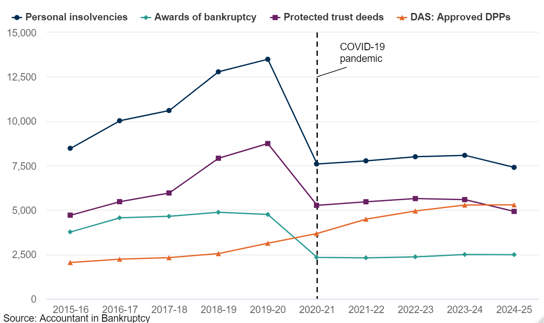
In 2024-25, total personal insolvencies, which include both bankruptcies and protected trust deeds, decreased by 8.4% to 7,403.
There were 2,483 bankruptcies awarded, a decrease of 0.5% from 2,495 in the previous year. There were 4,920 protected trust deeds registered in 2024-25 compared to 5,587 in 2023-24, a decrease of 11.9%.
There were 5,292 DAS debt payment programmes approved, an increase of 0.3% compared with 5,278 in the previous year. Around £48.0 million was repaid to creditors through the scheme in 2024-25. This means as at the end of March 2025 around £457 million of debt has been repaid to creditors through DAS since the changes made to the scheme in 2011. Just over 18,875 people have now completed a debt payment programme through the scheme with around 19,850 people currently in a programme.
The following chart shows the number of statutory debt solutions by type for the financial years 2015-16 to 2024-25:
Chart 1: Statutory Debt Solutions by type, 2015-16 to 2024-25
AiB are responsible for recording and reporting statistics on corporate insolvency of companies registered in Scotland. AiB play no other part in the administration of these cases.
The number of businesses registered in Scotland entering liquidation or receivership increased in 2024-25 compared with the previous year. There were 1,175 corporate insolvencies recorded, 7 more than in 2023-24.
This chart shows the trend in the number of corporate insolvencies and members’ voluntary liquidations in Scotland for the financial years 2015-16 to 2024-25:
Chart 2: Corporate insolvencies and Members’ Voluntary Liquidations, 2015-16 to 2024-25
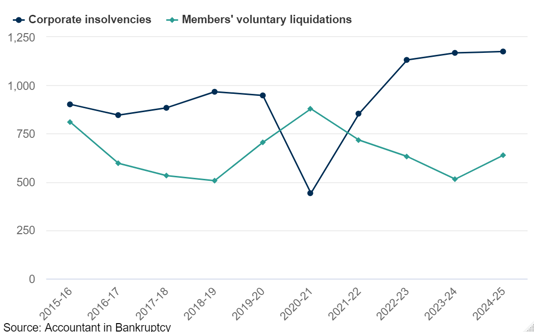
Compulsory liquidations increased by 8.3% from 446 in 2023-24 to 483 in 2024-25.
There were 639 members’ voluntary liquidations, an increase of 24.1% from 515 the previous year.
In 2024-25 there were no receivership of a company registered in Scotland recorded (2023-24 1 recorded).